November 11, 2026
A low-speed fender bender often seems deceptively harmless. When a vehicle sustains a minor impact in a parking lot or a low-speed traffic scrape, the exterior damage might appear limited to a scuffed plastic bumper cover, a dented fender, or a cracked headlight assembly. Because the vehicle may still start, drive in a straight line, and brake without making obvious grinding sounds, many drivers assume that repairing the sheet metal and repainting the panel is all that is required.
However, modern automobiles are engineered as unified structural systems. Kinetic energy from even a minor collision does not simply stop at the outer cosmetic shell; it travels through the bumper reinforcement bar, transfers into the subframe, and disperses into the suspension geometry. Overlooking wheel alignment compromises structural safety, accelerates tire degradation, and impairs electronic stability controls. Performing a precise four-wheel alignment is a fundamental phase of comprehensive collision repairs that ensures a vehicle returns to its exact factory driving specifications.
Examining the Physics of Fender Impacts
Beneath the outer flexible bumper fascia sits a rigid impact bar mounted to the frame rails or unibody apron via energy-absorbing crush boxes. When another vehicle or stationary object strikes a front fender or bumper corner, that force rarely hits dead-center. Instead, an offset or oblique blow exerts severe rotational and lateral torque across the front axle.
Because the wheel assemblies, steering knuckles, and control arms sit just inches behind the outer fender panels, even a minor push against the tire or wheel rim can bend or displace delicate mechanical hardware. Cast aluminum and stamped steel suspension parts are engineered to handle vertical loads from road bumps, but they possess far less tolerance for lateral impacts. Even when the wheel rim shows no visible cracks or scrapes, the inward shock can nudge the subframe out of alignment, shift the strut tower, or stretch a tie rod by just a few millimeters. That microscopic displacement is more than enough to throw the entire chassis geometry out of balance.
Understanding the Geometry of Four-Wheel Alignment
Automotive engineers design suspension systems around precise geometric planes measured in tenths of a degree. A comprehensive four-wheel alignment evaluates and adjusts three primary suspension angles on both the front and rear axles:
- Camber: This represents the inward or outward tilt of the tire when viewed directly from the front of the vehicle. Negative camber means the top of the tire tilts inward toward the engine compartment, while positive camber means it tilts outward. An off-center fender impact often forces a strut or steering knuckle inward, creating severe negative camber that places excessive pressure on the inner edge of the tire tread.
- Caster: Caster measures the forward or rearward slope of the steering axis relative to a vertical line, visible when viewing the vehicle from the side. Proper positive caster ensures directional stability, provides steering wheel centering force, and prevents the vehicle from wandering at highway speeds. A strike against the front bumper can push the lower control arm rearward, distorting the caster angle and causing erratic steering feedback.
- Toe: Perhaps the most sensitive alignment setting, toe describes the angle at which the tires point inward or outward relative to the longitudinal centerline of the vehicle, much like looking down at your own feet. Incorrect toe settings—even by fractions of an inch—cause the tires to scrub sideways against the pavement rather than roll freely, causing rapid friction wear and lower fuel efficiency.
While some older vehicles allowed for two-wheel front alignments, virtually all modern passenger cars, crossovers, and trucks require a four-wheel alignment. If the rear axle thrust angle is crooked—such as after a rear quarter-panel impact—the vehicle will "dog-track," forcing the front wheels to steer continuously against the rear drift. Incorporating precision four-wheel measurements is a standard procedure during professional collision repairs to verify that both axles remain strictly parallel.
Diagnosing Hidden Suspension and Chassis Shifts
One of the greatest dangers of skipping an alignment post-accident is that significant mechanical trauma can remain entirely hidden from view. In reality, that slight pull often indicates a bent strut tube, a displaced engine cradle, or a stretched steering rack mount.
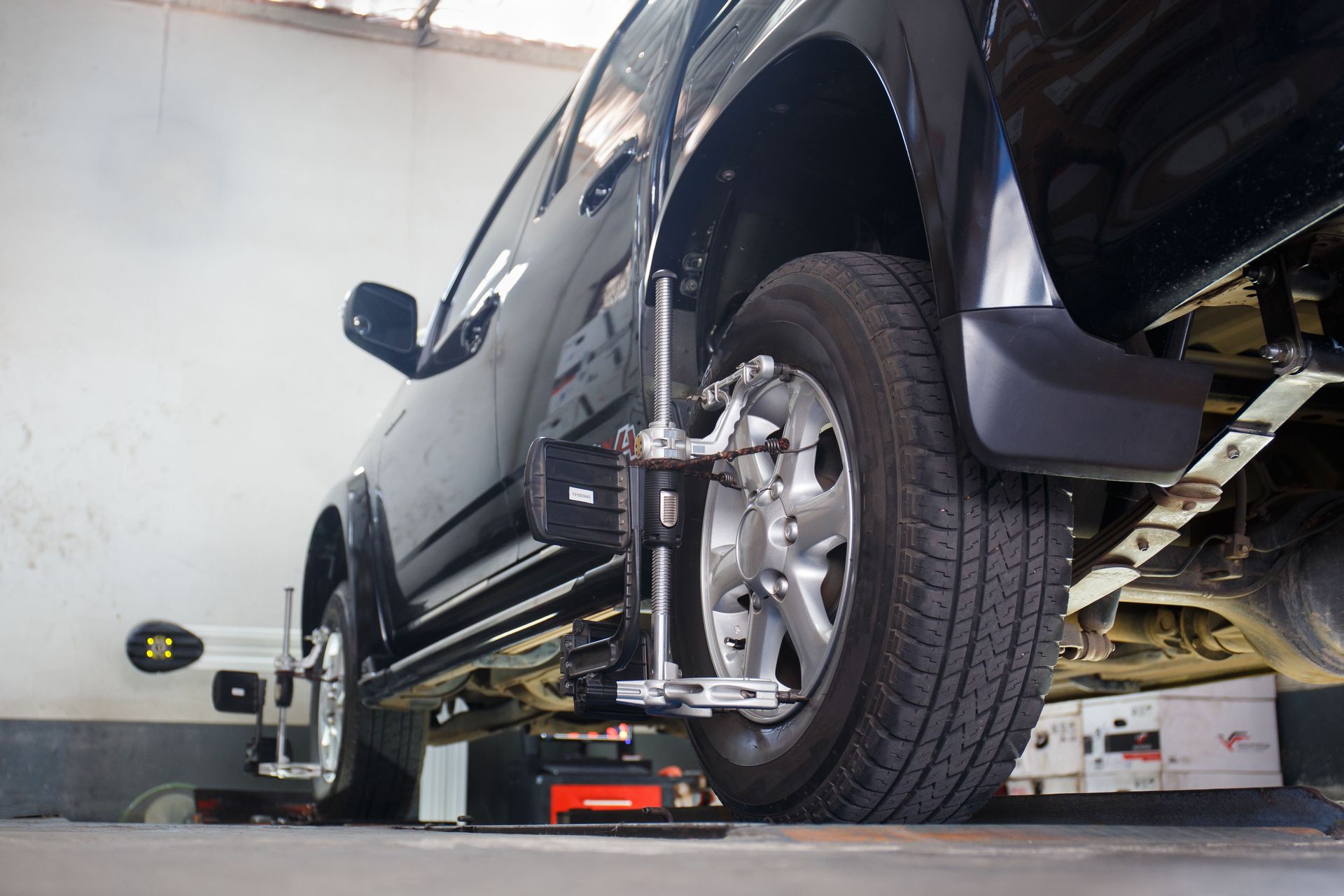
Certified technicians utilize computerized laser alignment racks to map the exact spatial orientation of all four wheels in real-time. By comparing the live measurements against original equipment manufacturer (OEM) technical databases, technicians can immediately isolate anomalies that escape visual scrutiny. If a wheel angle cannot be adjusted back within factory tolerances using standard eccentric bolts, it signals underlying structural deflection. Catching these hidden flaws prevents drivers from operating vehicles with bent structural components, making thorough diagnostics an indispensable element often overlooked during surface-level collision repairs.
Calibrating Advanced Driver Assistance Systems
Modern vehicles no longer rely solely on physical linkages to keep drivers safe; they depend on intricate digital networks known as Advanced Driver Assistance Systems (ADAS). Features like lane-keeping assist, adaptive cruise control, automatic emergency braking, and blind-spot monitoring rely on high-precision forward-facing cameras, radar arrays, and steering angle sensors (SAS).
These electronic systems operate under the assumption that the vehicle's mechanical thrust line directly matches the camera and radar targeting lines. When a fender impact knocks the suspension out of alignment, the driver must turn the steering wheel slightly off-center to travel in a straight line. The onboard steering angle sensor reads this permanent rotation as an intentional turn, confusing the stability control computer.
According to BodyShop Business, advances in automotive technology will mean over 70% of vehicles need post-collision calibration by 2028. An alignment rack serves as the mandatory baseline foundation for these electronic calibrations; technicians cannot properly reset optical radar units or recalibrate forward cameras until the physical chassis and four-wheel alignment angles match factory specifications down to the millimeter. Overlooking this connection leaves critical crash-avoidance systems misaligned, underscoring why sensor integration is integral to modern collision repairs.
Preventing Accelerated Tire Wear and Handling Hazards
Driving a car with misaligned suspension geometry destroys tire treads at an alarming rate. Even a slight toe misalignment drags a tire sideways across the asphalt for dozens of feet every mile, resulting in "feathering"—a condition where the edges of the tread blocks become sharp and saw-toothed.
Improper camber causes rapid inner or outer shoulder wear, exposing steel belts in extreme cases and creating sudden blowout risks. Beyond the financial burden of replacing tires prematurely, misaligned geometry compromises traction in adverse weather. Restoring proper contact patches through precise adjustments represents a crucial quality control milestone in collision repairs that protects both your pocketbook and your safety.
Protecting Drivetrain Components from Premature Fatigue
Suspension geometry does not operate in isolation; it interfaces directly with drive axles, constant-velocity (CV) joints, wheel bearings, and differential assemblies. When a fender collision forces a control arm or hub out of place, it alters the operating angle of the CV axle shafts.
Operating at an unintended angle forces the internal bearings of the CV joint to cycle through excessive lateral thrust, causing the protective rubber boots to tear and joint grease to break down under extreme heat. Over time, this mechanical strain translates into severe vibration, clicking noises during turns, and eventual axle failure. Resolving geometric binding before returning the vehicle to the road prevents progressive drivetrain wear, a disciplined practice that distinguishes thorough collision repairs from quick cosmetic patches.
The complex interdependence between body panel positioning, structural crash bars, unibody rails, mechanical suspension links, and modern electronic driver-assist cameras demands thorough inspection after any collision. Skipping a four-wheel alignment risks long-term mechanical failure, hazardous handling during emergency maneuvers, and premature tire replacement. Confirming that all four wheels track true to OEM standards ensures that your vehicle handles predictably, maintains traction across all driving surfaces, and reacts exactly as its designers intended. Committing to detailed structural evaluations remains an indispensable component of certified collision repairs.
If your vehicle has recently been involved in a fender impact or minor crash, bring it to Alex's Paint & Body Inc for a comprehensive inspection and precision alignment to ensure your car is restored to safe, like-new condition.